

Crypto Compliance
VASP Requirements by Country: Licensing, KYC, and the Travel Rule
What a VASP needs to operate in 12 jurisdictions in 2026, from the EU and UK to Costa Rica: the license or registration, the KYC rules, and the Travel Rule.
14 min read By the KYC-Chain team
A virtual asset service provider (VASP) needs two things before it serves customers in a regulated market: a license or registration from that market’s regulator, and an AML/CFT program that verifies its customers and screens their transfers. Both requirements come from FATF Recommendation 15, and each country implements them in its own law: the EU requires authorization as a crypto-asset service provider under MiCA, the United States requires registration with FinCEN and state money transmitter licenses, and Costa Rica has required registration with SUGEF since September 19, 2026.
This guide explains who counts as a VASP, what the FATF standard requires everywhere, and how 12 jurisdictions apply it as of November 2026, with the regulator’s own text linked for each. It closes with the controls every VASP needs and how crypto AML software supports them.
What is a VASP?
A virtual asset service provider (VASP) is a business that exchanges, transfers, or holds virtual assets for or on behalf of its customers. The FATF Glossary defines a VASP as any natural or legal person, not covered elsewhere under the FATF Recommendations, who as a business conducts one or more of five activities for or on behalf of another person:
- exchange between virtual assets and fiat currencies
- exchange between one or more forms of virtual assets
- transfer of virtual assets
- safekeeping or administration of virtual assets, or of instruments enabling control over them
- participation in and provision of financial services related to an issuer’s offer or sale of a virtual asset
A virtual asset, in the same glossary, is a digital representation of value that can be digitally traded or transferred and used for payment or investment, other than fiat currencies, securities, and financial assets the Recommendations already cover.
The FATF’s Updated Guidance for a Risk-Based Approach to Virtual Assets and VASPs, published in October 2021, tells countries to apply the definition by function rather than by label. Exchanges, brokers, custodial wallet providers, crypto ATM operators, and crypto payment processors are VASPs when they carry out these activities as a business. Stablecoins are covered by the guidance as virtual assets or other financial assets, and the creators, owners, and operators of a decentralized finance (DeFi) arrangement can be VASPs where they keep control or sufficient influence over it. A software developer who only writes code, or an individual who transfers crypto from their own wallet, is not.
National laws use their own terms for the same businesses, such as crypto-asset service providers in the EU and cryptoasset businesses in the UK, but the activities behind them are largely the FATF’s five.
What FATF Recommendation 15 requires of every VASP
Recommendation 15 of the FATF Recommendations, extended to virtual assets in October 2018, requires countries to ensure that VASPs “are regulated for AML/CFT purposes, and licensed or registered and subject to effective systems for monitoring and ensuring compliance.” Four requirements follow from it, and every regime in this article implements them in its own law.
- Licensing or registration. The Interpretive Note to Recommendation 15 states that VASPs “should be required to be licensed or registered,” at a minimum in the jurisdiction where they are created, and that countries may also require it of VASPs that serve customers in, or operate from, their territory. Authorities must keep criminals and their associates from owning or managing a VASP, and must identify and sanction businesses that operate without a license or registration.
- Supervision. VASPs must be supervised or monitored for AML/CFT by a competent authority, not by a self-regulatory body, with powers to inspect, sanction, and withdraw the license or registration.
- Customer due diligence. Recommendations 10 to 21 apply to VASPs, including customer due diligence (CDD), record keeping, suspicious transaction reporting, and targeted financial sanctions. For occasional transactions, the Interpretive Note sets the threshold above which CDD is required at USD/EUR 1,000.
- The Travel Rule. Originator and beneficiary information must be obtained, held, and sent with virtual asset transfers. Our article on the FATF Travel Rule sets out what it requires and how 13 jurisdictions apply it.
The FATF’s seventh Targeted Update on virtual assets and VASPs, published on July 16, 2026, found that 91 of the 109 jurisdictions reporting on the Travel Rule (83%) had passed legislation implementing it, but that many still struggle to put licensing and registration into practice and to identify the businesses carrying out VASP activity. It also highlighted offshore VASPs serving customers without a local license, which is why the regimes below increasingly reach any provider that serves their residents.
VASP requirements by country
The table summarizes how 12 jurisdictions license or register VASPs and apply the Travel Rule, as of November 23, 2026. Each subsection adds the KYC requirement and links the regulator’s own text.
| Jurisdiction | Regulator | License or registration | Travel Rule threshold |
|---|---|---|---|
| European Union | National competent authority; ESMA keeps the register | CASP authorization under MiCA | None |
| United Kingdom | Financial Conduct Authority (FCA) | MLR registration; FCA authorization from October 25, 2027 | Full information on cross-border transfers of £800 or more |
| United States | FinCEN and the states | MSB registration; state money transmitter licenses; BitLicense in New York | USD 3,000 |
| Singapore | Monetary Authority of Singapore (MAS) | Standard or major payment institution license for digital payment token services | S$1,500 |
| Hong Kong | Securities and Futures Commission (SFC) | Virtual asset trading platform license | HK$8,000 |
| United Arab Emirates | VARA (Dubai), FSRA (ADGM), Capital Market Authority, CBUAE | License per emirate or free zone, or federal | None; beneficiary verification from AED 3,500 a day (VARA) |
| Switzerland | FINMA and self-regulatory organizations | SRO membership, or a FINMA license | None |
| Japan | Financial Services Agency (FSA) | Crypto-asset exchange service provider registration | None |
| South Korea | Korea Financial Intelligence Unit (KoFIU) | Report to KoFIU, with ISMS certification | KRW 1 million; all amounts from February 2027 |
| Canada | FINTRAC; provincial securities regulators | MSB registration; dealer registration for trading platforms | C$1,000 |
| Australia | AUSTRAC; ASIC | VASP registration; ASIC license from April 8, 2027 | Domestic and cross-border transfers, from July 1, 2026 |
| Costa Rica | SUGEF | Registration under Article 15 quater of Law 7786 | USD 1,000 in one transfer or a calendar month |
European Union
A crypto-asset service provider (CASP) must be authorized by the competent authority of its home member state under Article 59 of MiCA, Regulation (EU) 2023/1114, and the authorization passports across the EU. The CASP rules have applied since December 30, 2024, and the transitional period for firms already operating under national law ended on July 1, 2026 at the latest, so a CASP serving EU customers today needs a MiCA authorization. ESMA lists them in its interim MiCA register.
CASPs have been obliged entities under the AML Directive since December 30, 2024, through Article 38 of the Transfer of Funds Regulation, which also applies the Travel Rule to every transfer without a threshold. The AML Regulation, (EU) 2024/1624, applies directly from July 10, 2027. On October 8, 2026, ESMA set the supervisory expectation that CASPs stop providing services in non-MiCA-compliant stablecoins to EU clients. Our article on MiCA covers authorization in detail.
United Kingdom
Cryptoasset exchange providers and custodian wallet providers must be registered with the FCA before they operate, under regulation 56 of the Money Laundering Regulations 2017, which has applied to them since January 10, 2020. The MLRs set the CDD requirements, and Part 7A applies the Travel Rule: names and account numbers accompany every transfer, and further originator information is required on cross-border transfers of £800 or more, the amount substituted for EUR 1,000 on June 30, 2026.
The regime is changing. The Financial Services and Markets Act 2000 (Cryptoassets) Regulations 2026, made on February 4, 2026, bring cryptoasset activities under FCA authorization from October 25, 2027. The FCA’s application window opened on September 30, 2026 and closes on February 28, 2027. Our guide to UK AML regulations covers the MLRs in full.
United States
A business that exchanges or transmits convertible virtual currency is a money transmitter under the Bank Secrecy Act, as FinCEN’s guidance FIN-2019-G001 sets out. It must register with FinCEN as a money services business (MSB) within 180 days of being established, foreign-located MSBs included, and maintain an AML program whose procedures include “verifying customer identification” (31 CFR 1022.210(d)(1)(i)(A)). The funds transfer rule requires records and verification for transfers of USD 3,000 or more, which is the US Travel Rule.
States license money transmission separately, and 31 states have enacted the Money Transmission Modernization Act, which covers virtual currency, in full or in part. New York requires a BitLicense under 23 NYCRR Part 200, whose section 200.15 requires licensees to “verify the customer’s identity, to the extent reasonable and practicable,” and to check customers against OFAC’s Specially Designated Nationals list. The CLARITY Act on market structure passed the House but failed a Senate cloture vote on September 15, 2026.
Singapore
A digital payment token (DPT) service provider needs a standard or major payment institution license from MAS under the Payment Services Act 2019, in force since January 28, 2020. MAS Notice PSN02 sets its CDD requirements, including the identification and verification of customers and beneficial owners, and its Travel Rule: names and account numbers on every transfer, and further originator information above S$1,500.
Since June 30, 2025, a digital token service provider incorporated in or operating from Singapore that serves only customers outside Singapore must be licensed under the Financial Services and Markets Act 2022. MAS has stated that it has set the bar high and “will generally not issue a licence.”
Hong Kong
A virtual asset trading platform must be licensed by the SFC under Part 5B of the Anti-Money Laundering and Counter-Terrorist Financing Ordinance (AMLO), a regime in force since June 1, 2023; the SFC publishes the list of licensed platforms. Platforms carry out CDD under Schedule 2 of the AMLO and apply the Travel Rule from HK$8,000, with names and account numbers below it.
The Virtual Asset Services Legislation (Amendment) Bill 2026, gazetted on November 20, 2026, would license virtual asset dealing, advisory, management, and custody services, and goes to the Legislative Council for first reading on December 2, 2026.
United Arab Emirates
The regulator depends on where the business operates. In Dubai, outside the DIFC, a VASP must obtain a license from VARA before carrying out any of eight virtual asset activities, and VARA’s Compliance and Risk Management Rulebook sets its customer due diligence rules. Its Travel Rule circular of February 2026 requires originator and beneficiary information on transfers of any amount, and verification of an unverified beneficiary from AED 3,500 a day. In Abu Dhabi Global Market, a VASP needs a Financial Services Permission from the Financial Services Regulatory Authority.
Onshore, the federal Capital Market Authority, successor to the Securities and Commodities Authority, issued a new virtual assets framework on April 13, 2026. The Central Bank of the UAE regulates payment tokens under its Payment Token Services Regulation, and Article 62 of Federal Decree-Law No. 6 of 2025 brings licensed financial activities carried out through virtual assets or decentralized finance under its licensing, with a transition that ended on September 16, 2026.
Switzerland
Switzerland has no separate crypto license: a business that trades virtual currencies or transfers them for customers is a financial intermediary under the Anti-Money Laundering Act and must join a FINMA-recognized self-regulatory organization (SRO), unless it holds a FINMA license such as a banking, FinTech, or DLT trading facility license. Article 51a of the FINMA Anti-Money Laundering Ordinance requires the customer to be identified when virtual currency exchange transactions, alone or linked, reach or exceed CHF 1,000.
The Swiss Travel Rule is strict. Article 10 of the ordinance has no threshold, and FINMA Guidance 02/2019 states that it provides no exception for unhosted wallets: until an institution can exchange the required information, it may transfer only to and from external wallets whose owner it has identified and whose ownership has been proven by suitable technical means.
Japan
A crypto-asset exchange service provider must register with the FSA under the Payment Services Act, which has required registration since April 2017; the FSA publishes the register of crypto-asset exchange service providers. Customer identity verification follows the Act on Prevention of Transfer of Criminal Proceeds, which has also applied the Travel Rule since June 2023, without a threshold.
On July 15, 2026, the Diet enacted an act amending the Financial Instruments and Exchange Act and the Payment Services Act, which brings crypto-assets under securities-law rules. It takes effect on a date set by Cabinet Order within one year of its promulgation.
South Korea
A VASP must report its business to KoFIU under the Act on Reporting and Using Specified Financial Transaction Information, in force since March 25, 2021, before it operates. The report requires information security management system (ISMS) certification, and an exchange that offers trading against the Korean won also needs a real-name verified account with a partner bank. The Act on the Protection of Virtual Asset Users added user-protection and market-conduct rules from July 19, 2024.
The Korean Travel Rule applies to transfers of KRW 1 million or more. Rules approved on August 11, 2026 extend it to transfers of all amounts between registered VASPs, from February 2027.
Canada
A business dealing in virtual currencies is a money services business and must register with FINTRAC before operating, as must a foreign MSB serving people in Canada. Under section 95 of the Proceeds of Crime (Money Laundering) and Terrorist Financing Regulations, it must verify the identity of a person who requests a virtual currency transfer or exchange of C$1,000 or more, and the Travel Rule applies from the same amount.
The Canadian Securities Administrators require platforms that serve Canadians, including those located outside Canada, to register with the provincial and territorial securities regulators, and a platform already in operation signs a pre-registration undertaking to continue while its application is reviewed.
Australia
Digital currency exchange providers have been required to register with AUSTRAC since 2018. The AML/CTF Amendment Act 2024 renamed the register the Virtual Asset Service Provider Register and extended it beyond exchange with fiat to exchange between virtual assets, transfers on behalf of customers, custody, and services related to an issuer’s offer or sale. The obligations for these services and the Travel Rule for virtual asset transfers took effect on July 1, 2026, according to the Transitional Rules 2026 explanatory statement.
The Corporations Amendment (Digital Assets Framework) Act 2026 commences on April 8, 2027, and requires operators of digital asset platforms and tokenized custody platforms to hold an Australian financial services license; operators that apply within six months can continue until ASIC decides.
Costa Rica
Costa Rica regulates VASPs under Law 10961, which adds Article 15 quater to Law 7786, the country’s AML/CFT law. The law was published in La Gaceta on June 19, 2026 and took effect three months later, on September 19, 2026. Its definition of a VASP follows the FATF’s but also covers businesses acting on their own account.
Every VASP must register with SUGEF, the General Superintendency of Financial Entities, which supervises it for AML/CFT and keeps a central register. VASPs must identify customers and beneficial owners and carry out due diligence using reliable data or information from independent sources, apply controls to PEPs, report suspicious transactions to the financial intelligence unit, and obtain and keep the FATF’s originator and beneficiary information on transfers. The detailed rules are in SUGEF Agreement 13-19, as amended by the National Council for Supervision of the Financial System (Conassif) from November 11, 2026, with six months for VASPs to adapt. Occasional customers need CDD, and transfers need full originator and beneficiary information, from USD 1,000 in one transaction or a calendar month.
What every VASP needs in place
The regimes differ in their licenses, thresholds, and timetables, but a regulator in any of them examines the same controls before it grants a license and at each inspection.
- A license or registration for each market. Map each service to the legal categories of every market where you are established or serve customers: the same exchange is a CASP in the EU and a money services business in the United States.
- A documented risk assessment. Regulators in every regime above expect a VASP to assess its money laundering, terrorist financing, and sanctions risks by customer, product, channel, and geography, and to keep the assessment current.
- Fit and proper ownership and a compliance officer. Regulators vet a VASP’s directors, controlling shareholders, and beneficial owners, and expect a named compliance officer with the authority to act.
- Customer due diligence at onboarding. Individual customers have their identity verified, corporate customers are verified against company registries together with their directors and beneficial owners, and enhanced due diligence applies where the risk is higher.
- Sanctions and PEP screening with ongoing monitoring. Customers are screened against sanctions lists and for politically exposed persons (PEPs) at onboarding and rescreened as the lists change.
- Wallet screening and transaction monitoring. The wallets customers deposit from and withdraw to are screened for exposure to sanctioned entities, mixers, and scams, and transactions are monitored against rules that reflect the risk assessment.
- Travel Rule compliance. Originator and beneficiary information is sent with outgoing transfers and checked on incoming ones.
- Records and reporting. Customer records and transaction data are retained for the period national law sets, and suspicious transactions are reported to the financial intelligence unit.
KYC-Chain
How KYC-Chain supports VASP compliance
KYC-Chain gives crypto exchanges, custodians, payment providers, and other VASPs one platform for customer due diligence: identity verification, KYB, screening, wallet screening, and risk scoring in one case per customer.
- Identity verification Document checks, a selfie with a passive liveness check, and database checks in 37 countries.
- Business verification Company registry checks in 149 jurisdictions, with directors, shareholders, and beneficial owners verified in the same case.
- Screening and monitoring Sanctions, PEP, and adverse-media screening, with ongoing monitoring at an interval set for each risk level.
- Wallet screening Wallets screened on 144 blockchains in real time, with incoming and outgoing risk scores and counterparties on the 24 with full coverage, and attribution and blocklist matches on the rest.
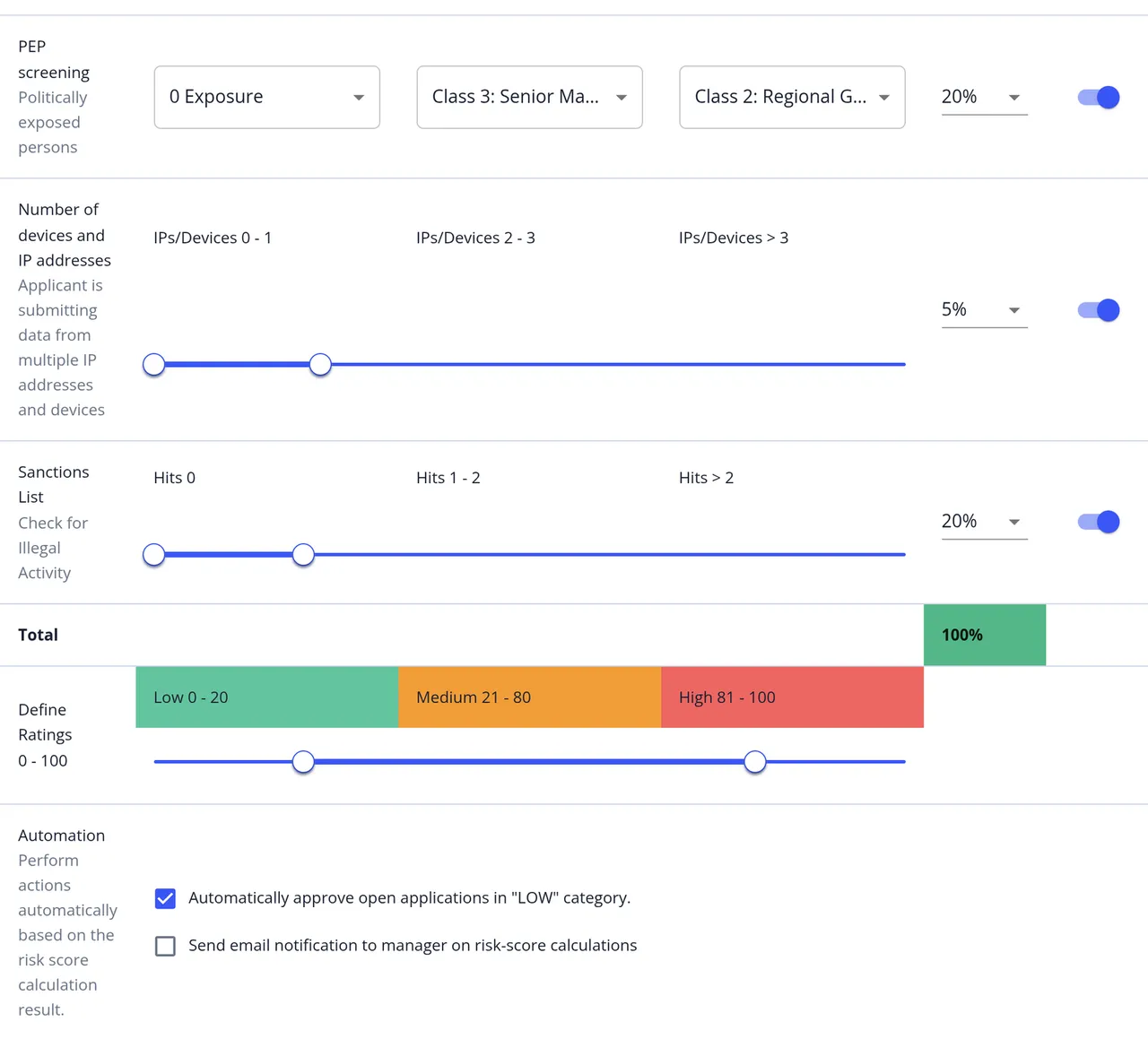
- Risk scoring Scorecards that weigh screening results, FATF lists, the Corruption Perceptions Index, nationality, and residency.
- Audit trail Four-eyes approval and an audit trail of every application and every configuration change, with PDF reports for auditors and regulators.
Conclusion
Every VASP needs a license or registration in each market it serves and an AML/CFT program built on customer due diligence, screening, and the Travel Rule. What differs is the detail, from a MiCA authorization that passports across the EU to a SUGEF registration that is expressly not a license, and from no Travel Rule threshold in the EU, Switzerland, and Japan to USD 3,000 in the United States. The map is still moving, with new regimes due in the UK, Japan, and Australia in 2027 and a dealing and custody bill in Hong Kong. A VASP whose customer due diligence, screening, and records already meet the strictest of these regimes can take on the next market without rebuilding its controls. To see how KYC-Chain can be configured for your licensing requirements, talk to our team.
This article is for general information only and is not legal, regulatory, or compliance advice. It may contain errors or be out of date. Check the primary sources linked in the text and take professional advice before acting on it. KYC-Chain accepts no liability for decisions made on the basis of this article.
Latest Articles
Stay Informed with Industry-Specific Compliance Insights
-
 What the EU’s 5th AML Directive (5AMLD) required, how 6AMLD and the 2024 AML package replace it, and what changes…Updated
-
 This guide sets out what to compare when choosing identity verification software, from document coverage and liveness to accuracy, data…
-
 What MiCA requires of crypto-asset service providers in 2026, where its KYC and AML rules come from, and the checks…Updated
