

KYC Software
How to Choose Identity Verification Software: What to Compare
This guide sets out what to compare when choosing identity verification software, from document coverage and liveness to accuracy, data protection, and pricing.
14 min read By the KYC-Chain team
Identity verification software confirms that an applicant is a real person and the rightful holder of the identity document they present. It checks the document, compares a selfie with the document photo, and in some countries matches the applicant’s details against official or commercial databases. For a regulated business, it is how customer due diligence is carried out remotely, which makes choosing identity verification software a compliance decision as well as a procurement one: the software runs the checks, but your firm answers to the regulator for them.
This guide explains what the software does, what the FATF, EU, UK, and US rules require of the verification it performs, and the criteria on which to compare vendors, with the questions to ask under each and a checklist for a request for proposal (RFP).
What identity verification software does
Identity verification software combines several checks, each of which establishes something different, and a vendor’s strength in one does not prove strength in the others.
| Check | What it establishes | What it leaves open |
|---|---|---|
| Document verification | The document is genuine, unexpired, and unaltered, and its machine-readable zone (MRZ) matches the printed data read by OCR | Whether the person presenting it is its holder |
| Chip reading (NFC) | The data and photo on the chip of an electronic passport or identity card, signed by the issuing state | Documents without a chip, and phones without NFC |
| Face matching | The selfie and the document photo show the same person, above a set similarity threshold | Whether the selfie was taken live |
| Liveness detection | A live person was in front of the camera, not a printed photo, a screen, a mask, or a synthetic face | Whether the person is sanctioned or high risk |
| Database check | The name, date of birth, address, or ID number matches an independent record, such as a national ID registry or a credit bureau | Whether the applicant is the person in the record |
Chip reading deserves a separate decision. The chip in an electronic passport or identity card follows ICAO Doc 9303, whose security mechanisms let software confirm that the stored data and photo were signed by the issuing state and not altered since. The European Banking Authority’s remote onboarding guidelines ask firms to consider using chip data where the document holds it and access is technically feasible. Because the applicant must hold the document against an NFC-capable phone, chip reading adds a step, which suits the customers and documents whose risk justifies it.
Many products add fraud signals, such as a document number already used in another application and the device behind each step, and take proof of address from a utility bill or a database check.
Who needs identity verification and what the law requires
Every business subject to anti-money laundering and countering the financing of terrorism (AML/CFT) rules that onboards customers remotely needs a reliable way to verify identity, from banks and payment institutions to crypto-asset service providers and gambling operators. The rules set the outcome the verification must achieve and the evidence to keep, and leave the technology to the firm.
The international standard
FATF Recommendation 10 requires financial institutions to identify the customer and verify that customer’s identity “using reliable, independent source documents, data or information.” The FATF’s Guidance on Digital ID (March 2020) adds that remote identification relying on reliable, independent digital ID systems with appropriate risk mitigation measures “may present a standard level of risk, and may even be lower-risk.”
European Union
The Anti-Money Laundering Regulation, Regulation (EU) 2024/1624 (AMLR), applies from July 10, 2027. Article 22(6) allows two routes for verifying a customer: “the submission of an identity document, passport or equivalent” together with, where relevant, information from reliable and independent sources, or electronic identification means that meet the eIDAS Regulation’s assurance levels “substantial” or “high.” The Anti-Money Laundering Authority (AMLA) consulted from February 9 to May 8, 2026, on draft technical standards on customer due diligence, and its final draft of September 30, 2026, keeps the identity document and electronic identification as the defaults and permits a remote document solution only when neither can be used, with controls confirming that the person presenting the document is its holder.
Until the AMLR applies, the EBA Guidelines on the use of remote customer onboarding solutions (EBA/GL/2022/15), applicable to credit and financial institutions since October 2, 2023, state what a supervisor expects of the software. For unattended onboarding, firms should perform liveness detection and use “strong and reliable algorithms” to match the selfie with the document photo, and where they accept a photo of a document, check that it was not displayed on a screen. Before adopting a solution, a firm should complete a pre-implementation assessment that includes tests for impersonation fraud, and be able to show its supervisor the outcome.
United Kingdom
Under regulation 28 of the Money Laundering Regulations 2017, “verify” means verify on the basis of documents or information obtained from a reliable source that is independent of the person being verified. Regulation 28(19) allows information from an electronic identification process to count as such a source where the process is secure from fraud and misuse and gives the assurance needed to manage the money laundering and terrorist financing risks.
United States
A bank’s customer identification program under 31 CFR 1020.220 must include risk-based procedures for verifying each customer’s identity “to the extent reasonable and practicable,” enough to form “a reasonable belief that it knows the true identity of each customer.” Verification may use documents, non-documentary methods such as comparison with a consumer reporting agency or public database, or both, and the procedures must address customers who open an account without appearing in person.
The criteria to compare
The criteria run from whether the software can verify your customers at all, through how reliably it does so, to what it costs your team to run.
Document and country coverage
Coverage should be measured against your own customers, not a vendor’s headline figure. A count of document types says little until you know which documents from your customers’ countries are fully supported, with authenticity checks, and which are read for data only. Compare like with like as well: a database-only service and a document and selfie service answer different questions.
Questions to ask:
- Which document types from our main countries are fully supported, and which checks run on each?
- In which countries are database checks available, against which sources, and which fields do they verify?
Liveness detection and deepfake resistance
Liveness detection and document checks are the controls that generative AI is now used to defeat. FinCEN’s alert of November 13, 2024 reports that criminals have used generative AI “to create falsified documents, photographs, and videos” to circumvent customer identification, and lists as a red flag a customer who uses a third-party webcam plugin during a live verification check. A presentation attack holds a printed photo, a screen, or a mask in front of the camera, and a generated face imitates a real one.
Passive liveness runs on the selfie the applicant has already taken, while active liveness asks for a movement; active and passive liveness compares the two.
Questions to ask:
- Which attacks does the liveness check reject: printed photos, screens, masks, AI-generated faces?
- How do you detect AI-generated or edited documents?
Accuracy, pass rates, and how they are measured
An accuracy figure means nothing without its definition: a “pass rate” may exclude abandoned applications, count a second attempt as a pass, or include manual approvals. Ask how each figure is defined, and what share of applications goes to manual review.
Questions to ask:
- How is your pass rate defined, and does it count second attempts and manual approvals?
- What share of applications goes to manual review, and how quickly is it cleared?
- Can we run a trial on a sample of our own customers’ documents before we sign?
Manual review and fallback
No automated check resolves every application, so the software must pass the remainder to a reviewer with everything needed to decide. The EBA guidelines expect a firm to define which steps are automated and which require human intervention, and to interrupt the process, restart it, or redirect it to face-to-face verification when the evidence is too poor to check. The US rule likewise requires procedures for customers who cannot present a photo ID.
Questions to ask:
- Does the reviewer see the images, the face-match score, the liveness result, and each check in one view?
- Can a reviewer override a result with a recorded reason or request a new document or selfie?
AML screening and the rest of the workflow
Identity verification is one step of customer due diligence. Each verified customer must also be screened against sanctions and politically exposed persons (PEPs), rated for risk, and monitored, and a business customer’s beneficial owners go through the same screening; many firms also check adverse media. When those steps run in separate systems, the evidence for one decision is split across several records. The KYC onboarding process shows how the steps connect.
Questions to ask:
- Are screening, risk scoring, and the onboarding decision recorded in the same case as the identity results?
- Is screening repeated during the relationship, and are customers asked to re-verify when a document expires?
Configuration by risk
A risk-based approach applies different checks to different customers, and the software should do so without a developer. A low-risk retail customer might need a document and a selfie, while a high-risk customer also needs a database check, proof of address, and a stricter face-match threshold. The EBA guidelines expect firms to define which customers and products are eligible for remote onboarding, so the flows must differ.
Questions to ask:
- Can our compliance team set the checks, thresholds, accepted documents, and number of attempts for each flow without code?
- Can rules restrict issuing countries, raise the risk rating, or approve low-risk applications automatically?
Data protection and data residency
Facial images processed to identify a person are biometric data under Article 4(14) of the GDPR, a special category whose processing Article 9 prohibits unless one of its exceptions applies. Large-scale processing of special-category data requires a data protection impact assessment under Article 35, and the vendor, as your processor, needs a contract that meets Article 28. The AMLR sets retention at five years after the relationship ends, after which personal data is deleted. The EU AI Act excludes from its high-risk biometrics category systems whose sole purpose is to confirm that a person is who they claim to be, which describes one-to-one face matching at onboarding.
Questions to ask:
- Where is our data hosted, and which sub-processors receive it?
- How are images retained, deleted, and exported at the end of the contract, and are they used to train the vendor’s models?
Integration options
The integration route decides how much engineering the project needs: an API with webhooks gives full control and requires the most work, a mobile SDK places capture inside your own app, and a hosted link, an embedded iframe, or a no-code portal can be live with little or no development. A poor camera flow produces unreadable images, whatever the checks behind it.
Questions to ask:
- Which routes are available, and can we start with one and move to another later?
- Can an applicant switch from a computer to a phone mid-flow, and is there a sandbox?
Audit trail and evidence
The evidence the software keeps is what an examiner reviews, often years later. Article 77 of the AMLR requires a copy of the documents and information obtained during customer due diligence, including through electronic identification, and the EBA guidelines ask for time-stamped, readable records that allow later verification. The US rule asks for a description of each document, the methods and results of verification, and the resolution of discrepancies.
Questions to ask:
- Does the audit trail record each check, attempt, and decision, with its time, user, and device, as well as configuration changes?
- Can we export a complete case as a PDF report and retrieve the evidence through the API?
Pricing models
Identity verification is priced per check, by subscription, or as a mix of both, and the lowest price per check does not always give the lowest total cost. Per-check pricing scales with volume but often comes with a minimum commitment or a prepaid balance, while a subscription may include a check allowance and charge for overage. Price a year of your expected volume under each model, including retries, database checks charged per country, screening, and reviewer seats; the guide to KYC verification steps and documents helps to estimate the checks each application needs.
Questions to ask:
- Is a failed or repeated attempt charged, and what are the minimum commitment, contract term, and setup fee?
- Can we estimate the cost of a flow before we use it?
Support and continued development
Attacks on identity verification change faster than most contracts, so a vendor’s capacity to keep improving its checks matters as much as today’s results. The EBA guidelines expect a firm to ensure that an outsourced provider informs it of proposed changes to the process or the solution. Support at the start matters too, because the first configuration decides how many cases reach your reviewers.
Questions to ask:
- Who helps us configure our flows and rules, and how are changes to the checks announced and documented?
- How have your checks changed in response to AI-generated documents and selfies?
A checklist for your request for proposal
The table lists the evidence to request from each vendor, so that the answers can be compared side by side.
| Criterion | Evidence to request |
|---|---|
| Coverage | Support level per document type for your main countries; database sources and fields by country |
| Liveness | The attacks the liveness check rejects, shown in a demonstration |
| Accuracy | How the pass rate is defined; the manual review share; results of a trial on your own documents |
| Manual review | The reviewer’s view, override and resubmission options, and fallback routes |
| Workflow | Whether screening, risk scoring, and decisions share one case |
| Configuration | A demonstration of per-flow checks and rules set without code |
| Data protection | Hosting location, sub-processors, data processing agreement, retention and deletion terms |
| Integration | API reference, SDK platforms, hosted or embedded options, sandbox access |
| Evidence | A sample case report and audit trail |
| Pricing | A priced year at your expected volume, with retries, minimums, and setup fees |
| Support | The onboarding plan, support channels, and change notification process |
How to test a shortlist
A structured test of two or three vendors turns their claims into your own evidence and can form part of the pre-implementation assessment the EBA guidelines expect.
- Define scope
- Build samples
- Run the test
- Review results
- Record the decision
1Define the scope of the test
The scope lists the customer types, countries, documents, and products the software will serve, with the checks your risk assessment requires for each, so that every vendor is tested on the same flows.
2Build a representative sample
The sample should resemble your real applicants in their countries, documents, and devices, and be large enough that no single result decides the outcome. It needs genuine documents alongside expired and tampered ones, photos of screens, printed photos, and AI-generated selfies, so that you measure how many genuine applicants each vendor rejects as well as how many impostors it accepts.
3Run the test in real conditions
Real applicants photograph worn or folded documents in poor light, with glare and blur, on older phones, and a test on clean images flatters every vendor.
4Review the results and the reviewer’s view
Compare each vendor’s results with the expected outcome, and have your reviewers work the referred cases in each product, since review time is a cost on every referred application.
5Record the decision
The assessment, its results, and the reasons for the choice belong in your compliance file, where they answer a supervisor’s question about how the solution was assessed before it went live.
Mistakes buyers make
Each is cheaper to avoid than to correct after launch.
- Comparing headline figures. A count of document types or countries says nothing about the documents your customers hold.
- Accepting a pass rate without its definition. Figures measured on different data and definitions cannot be compared.
- Buying identity verification alone. Screening, risk scoring, and case management bought separately leave your team to reconcile the evidence.
- Assuming the vendor carries the responsibility. The firm remains liable for outsourced checks, so the vendor’s evidence must be good enough for your own file.
KYC-Chain
How KYC-Chain handles identity verification
Document, selfie, and database checks that run in real time, with screening, risk scoring, and the audit trail in the same case.
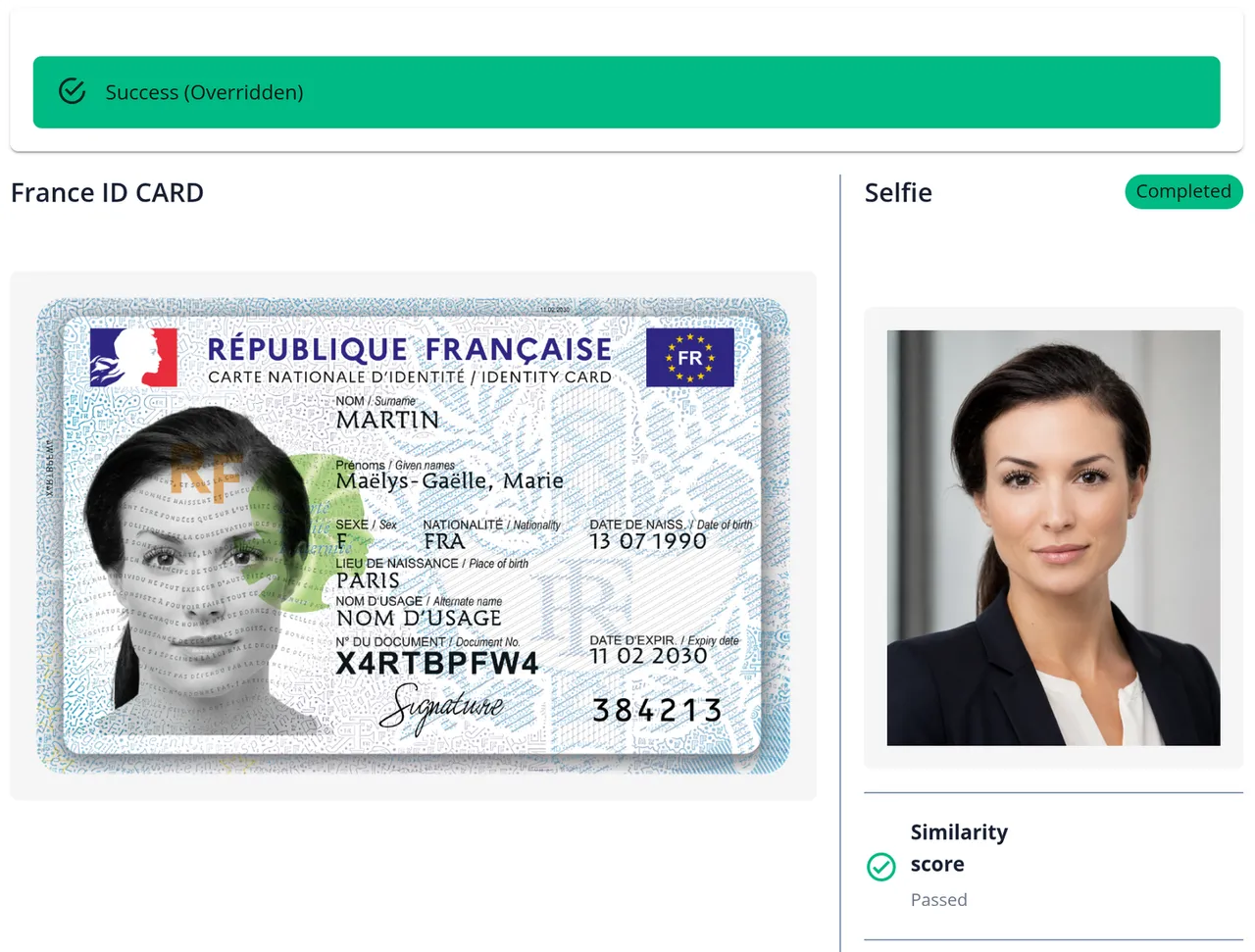
- Document verification 4,000+ identity document types from 240 countries and territories, checked by AI models for tampering, expiry, and a valid MRZ that matches the printed data.
- Selfie and passive liveness Face matching against a threshold set per KYC template, with a liveness check that rejects AI-generated faces, photos of a screen or a printed photo, and masks.
- Database checks National ID registries, credit bureaus, telecom and tax records, and commercial databases in 37 countries.
- Rules by risk Each KYC template sets the checks, thresholds, and accepted documents, and rules decide what each failed check does.
- One case Sanctions, PEP, and adverse-media screening, the risk score, and the reviewer’s decision alongside the identity results.
- Audit trail Every step recorded with its IP address and device, an audit trail of every application, and each case available as a PDF report.
Conclusion
Choosing identity verification software means choosing the evidence your firm will rely on when a regulator asks how a customer was verified. The FATF, EU, UK, and US rules leave the technology to you, but hold you responsible for its reliability and its records.
The vendors worth shortlisting cover your customers’ documents, perform well in a trial on your own documents, define their figures, and keep verification, screening, and decisions in one auditable case. To see how these criteria apply to your own flows, compare them with KYC-Chain’s identity verification, or contact sales for a demonstration with your requirements.
This article is for general information only and is not legal, regulatory, or compliance advice. It may contain errors or be out of date. Check the primary sources linked in the text and take professional advice before acting on it. KYC-Chain accepts no liability for decisions made on the basis of this article.
Latest Articles
Stay Informed with Industry-Specific Compliance Insights
-
 What the EU’s 5th AML Directive (5AMLD) required, how 6AMLD and the 2024 AML package replace it, and what changes…Updated
-
 VASP Requirements by Country: Licensing, KYC, and the Travel Rule What a VASP needs to operate in 12 jurisdictions in 2026, from the EU and UK to Costa Rica: the…
-
 What MiCA requires of crypto-asset service providers in 2026, where its KYC and AML rules come from, and the checks…Updated
